
|
 |
 |
 |
 |
 |
 |
 |
 |
 |
Nadezhda's corner | Meet the Wrights | UK | USA | Canada | N.Zealand | Australia | Pen |  |
|
|
Remembrance DayYou may remember my Dutch friends, George and Truus, about whom I have written before in School English. I sent them, as I usually do, a calendar for the coming year and, in thanking me, George commented, “Thank you for sending the Calendar for 2008. I am always glad to receive it, but also a little bit sad because it means that this year is almost over.”He went on to mention some of his experiences during WWIII when the Netherlands, like most of Europe, including a large part of the USSR, was occupied by German troops. 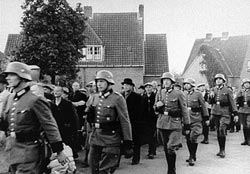 A round-up in Netherlands, 1940s This harrowing6 personal account reminded me of some of my own experiences during that time – not that they compared with the severe7 conditions endured by George and other people in occupied Europe who did not collaborate with the invadersVI: The 11th November is our Remembrance SundayVII when ceremonies are conducted and church services are held throughout the land as we remember those killed in the various wars of the 20th and 21st centuries. I think sometimes that it would be good if as much attention was given to those who served but did not die, as it was often just a matter of chance – a bullet an inch or two either way making the difference. A hundred years ago we had a great author, poet and Nobel LaureateVIII, Rudyard KiplingVIII, who wrote about the way everyone needs and respects a soldier when danger threatens, but forgets him when the danger has passedX. That is as true today as it was then unfortunately. It was interesting to read of George’s experiences during the warXI and the memories that are obviously fresh with him still. I think we in England had things much easier by comparison8. I have also been reading an autobiography by an American radio and TV personality, Walter CronkiteXII, who was a war correspondent during WWIIXIII, and I think none of us who lived through those times will ever forget them. We were very fortunate that we were not occupied and the severe bombing continued for only a few years at the beginning and culminated in V1 (flying bomb) and V2 rocketXIV attacks at the end. We too had a near miss as the house next to ours (it was semi-detached9, so it was part of the same structure) was destroyed by a bomb and the dividing wall collapsed10 so that the interior of our house was open to passers by like an open dolls’ house. At the time, I was aggrieved11 to have missed the excitement as I was in hospital having my appendix removed. I cannot imagine how worried my parents must have been by it all happening at once. When I got home, my cousin and I had the job of keeping looters12 (and the curious) from creeping13 underneath the temporary tarpaulin14 into our house. I am ashamed to say that it all seemed a game to me at that age; I could remember only very little about life before it started, so it was just normal for me. Many houses were destroyed in our area as it was near the vital15 London docks, a prime target for the LuftwaffeXV, but the vacant sites were exciting places for us to play amongst the debrisXVI. My school continued throughout the war and the local library remained open most of the time so I was well occupied as I was an enthusiastic reader, generally preferring a book to playing team games. 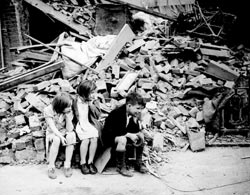 Children in London, 1940 To be concluded… - by David Wright (UK)
I The Second World War which lasted from 1939 to 1945 – also known in Russia as the Great Patriotic War after the breach in 1941 of the so-called Molotov-Ribbentrop Pact, officially (in English) the Treaty of Non-aggression between Germany and the Union of Soviet Socialist Republics
II A town and district in the south-eastern part of the Netherlands. III A Dutch (and German) word for a police raid or round-up. IV Those who resisted or were unfit for work, eg too old, crippled, etc. V A district in the north of the Netherlands which has its own dialect, different from that spoken in Roermond or Geleen where George and Truus now live. Some people there even want it to be an independent country! VI Many of the French did collaborate and were allowed a degree of self-governance in what was called Vichy France. Other countries like Spain, Ireland and the Vatican helped the Nazis in less conspicuous ways. Italy joined Germany in the Axis until it was clear that the Allies were going to win when they changed sides again. VII This is the date when the Armistice was signed in 1918 bringing to and end the fighting in WWI. VIII He was sounded out for the post of Poet Laureate, the title for the National Poet, and for a knighthood, but declined both honours. He was the Nobel Laureate for Literature in 1907 when he was the first English language winner and was (and is) the youngest ever winner. IX Named after a Lake in Staffordshire, not far from Runcorn (my home town), where his parents courted. He died a few months before I was born. X One of his most famous poems on this theme is “Tommy” – the archetypical name given to British soldiers of that era, like ‘Fritz’ for Germans, ‘Ivan’ for Russians, ‘GI Joe’ for US, etc. These names tended to be given to those whom we even grudgingly respected for their professionalism – I cannot recall one for French or Italians, they were more commonly known generically as Frogs and Wops respectively! Of course, one would not dream of using such pejorative and non-PC names today. XI I still think of WWII as the war! XII Originally Krankheidt – he had Dutch and German grandparents. XIII He lived and worked for the United Press in Moscow for some years. XIV The first of these was the V1, or ‘flying bomb’, a massive but slow and inaccurate weapon; followed by the more fearsome V2 which approached unseen and unheard. XV German air force. XVI A French word pronounced like deh-bree, which we appropriated as spoils of war! It can have various meanings depending on the context: ruin; the remains of something which has been destroyed; pile of rubbish or garbage; remains from landslides, volcanoes, avalanches or storms; floating rubbish in the sea or ocean cf flotsam; odd bits and pieces in space; etc, but for me, it will always conjure up memories of bombed out houses. XVII Usually we kept bantams, which were smaller than common hens, but were hardy, needed less food and were prolific layers. XVIII Nobody had refrigerators in those days – not in our part of the country anyway. 1 to shelter – укрываться 2 to render – приводить в какое-л. состояние 3 conscripted – рекрутированный 4 ghost town – опустевший город 5 sorrow – скорбь 6 harrowing – душераздирающий 7 severe – суровый 8 by comparison – при сравнении; 9 semi-detached – имеющий общую стену 10 to collapse – разрушаться 11 aggrieved – огорчённый 12 looter – мародер 13 to creep – красться 14 tarpaulin – брезент 15 vital – жизненно важный 16 ration coupon – продовольственная карточка 17 gravy – подливка 18 staple – основная еда 19 segregated – разделённый 20 fluffy – пушистый 21 heater – обогреватель 22 obnoxious – отвратительный 23 bran – отруби 24 to hoard – запасать 25 suet – нутряное сало 26 defiance – пренебрежение, сопротивление 27 to shake off – избавляться 28 tinned – консервированный Читать еще в этой рубрике:Читать еще в этом номере:
|
|
|
| 
| 
|
|
 |
Сайт является творческим продуктом ООО "Концепт". При использовании материалов ссылка обязательна. |  |






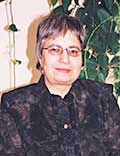 Надежда Никифоровна Рогожина, проректор по международным программам, зав. кафедрой лингвистики и межъязыковой коммуникации Самарского муниципального университета Наяновой, кандидат педагогических наук, доцент.